
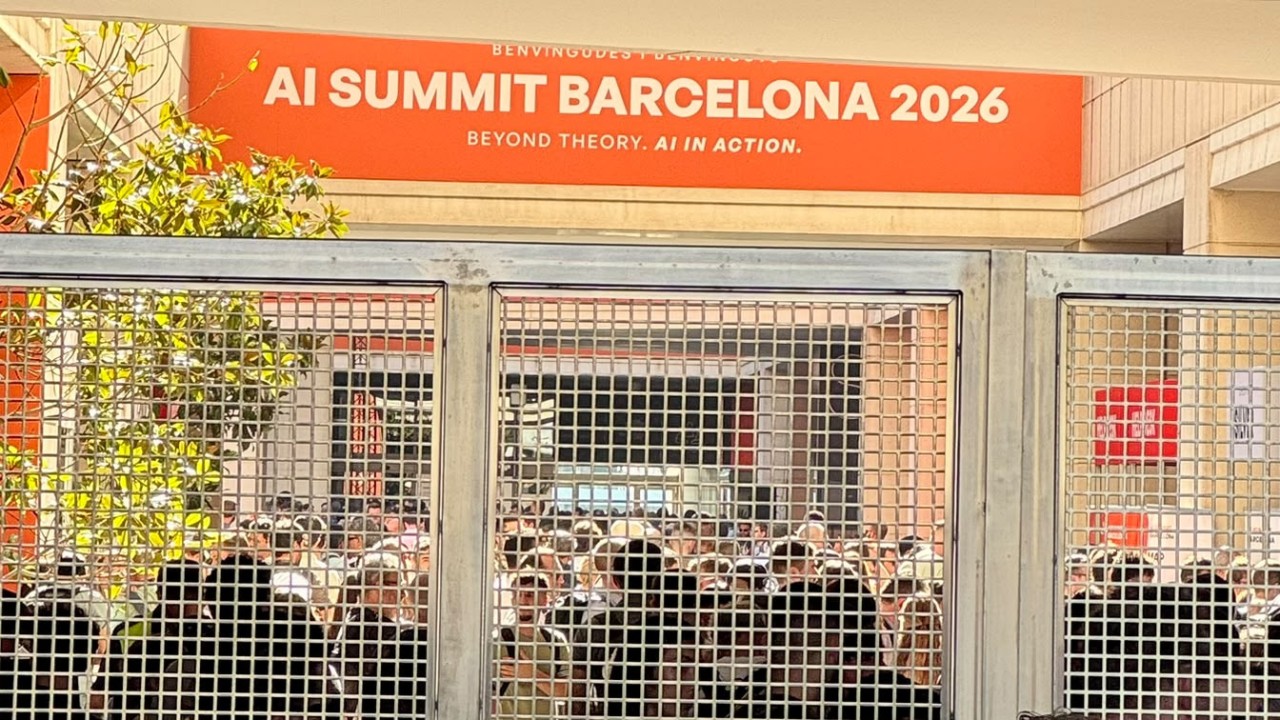
Last week, I went to the AI Summit Barcelona – to get out of my social-impact bubble and see what the commercial world is saying about AI.
Ironically, considering the fetishization of the private sector by many in development, it was without doubt the most poorly organised event I’ve ever been to in my life. They sold around 8,000 tickets,for into a venue that could comfortably fit maybe 20% of that number (even their own website lists only 1,800 seats across the whole venue)…
45 mins to get in, which I could’ve just about brushed off (even though I came late to avoid the rush), but then once inside I spent another 45 mins queuing for my first workshop before realising I was never getting in. I gave up and left. The level of complaints on LinkedIn (one of many examples here) suggests I did the right thing. There are currently nearly 200 of us, and growing, in a WhatsApp group chasing refunds.
It felt like the whole thing had been organised by Claude, and any second now it would do its usual non-apology and say
“Oh you’re right, I made a mistake, I planned for 100 attendees, not 10,000”!
Except it wasn’t a mistake. The seat numbers are on their own website, they knew how many tickets they’d sold, yet someone looked at both of those numbers and went ahead anyway. Back of an envelope calculations suggest probably over 2 million euros in ticket sales. Just saying…
Even though I never got to see the workshops, demos and how-to sessions that I wanted to – I did soak up a bit from wandering round the exhibition, listening to conversations in the queue and analysing the agenda. So…
If I had to say one thing about the private sector approach – fast, furious, possibly dangerous
Almost every exhibitor was selling the same thing. Not just “autonomous agents” or “agentic AI” but more specifically variations on ways to keep agents under control, stop them going off the rails. Observability, tracing, evaluation harnesses, orchestration layers, policy engines etc. Basically a hall full of companies selling the fix for what they sold everyone this time last year.
In the aid/development space we tend to be quite cautious – sometimes overly so. We try something, see what works, then seek to scale it. Usually quite slowly.
What I extrapolated from what I saw yesterday was more like: try something… it doesn’t work… deploy a few hundred autonomous agents to scale it anyway… then build something to try and fix all the problems those agents caused.
Don’t get me wrong, I use AI stuff every day and I love it. It can help me do genuinely brilliant stuff. The way I – and I think most of my social impact peers use it – with human guidance – it’s hard to get too alarmed about it. But seeing how some others operate, now I’m not so sure. I finally feel like I now better understand the widespread panic many feel about AI.
I actually asked Claude to check all 166 sessions against my gut-feel. Yes there are some exceptions – a speaker talking about delivery speed outrunning his ability to judge the output, a vendor that has restricted its agent to human-defined metrics, lots of talk of evaluation and human handoff. But the overwhelming feel is still of an industry that feels that they’ve “fixed” it. My perception is that it’s closer to they’ve “put a band-aid on it” and are hoping it holds!
What can social impact practitioners learn from the commercial approach?
- Show the unfinished stuff. That programme was full of people demonstrating half-built things in front of strangers. We tend to be more cautious about not demonstrating things until we have results, but that doesn’t fly with a tech that is evolving monthly. So long as it’s framed as demos and experiments, let’s share it all. We’ll learn more from each other’s early mistakes and missteps than we ever will from our (few) scaled success stories.
- “Promising” is not the same as “ready to scale”. We can also learn what not to do. Yes let’s show our early demos, but let’s not confuse them with something ready to roll-out. That is the single biggest danger I saw in where start-ups and even enterprise AI seems to be heading.
- Autonomy is not an inevitable destination. Beyond the hype, most autonomous AI is just not there yet. And they may never be! Sure, sometimes it might make sense to push towards full autonomy (when the tech is actually capable of it), but often it won’t, and that’s a perfectly good answer. “As autonomous as makes sense” is a perfectly good direction of travel – and sometimes the answer is “not very”. Especially in our work, it can be dangerous as hell to take the human out of the loop early.
- When someone says it’s fixed, ask exactly what they tested. You don’t need to code or even understand architecture to do this. If they’ve tested it properly they can explain what they did, and it should be a lot. If it takes them 10 seconds, they probably asked the AI to test and fix itself. And guess what, it probably didn’t.
- Notice who gets blamed when it goes wrong. There’s a session on the agenda explaining that agents fail because your systems aren’t set up right, not because the AI/agent isn’t good enough. Which is convenient. If the problem is always your plumbing, the answer is always something else to buy.
What I’d love them to learn from us
Often the stakes are lower in the private sector. Someone may go bankrupt, some customers may get angry, but (with a few obvious exceptions) nobody’s losing their lives or livelihoods. That doesn’t mean they shouldn’t be asking all the same questions we are used to – who is affected by introducing this tech, who got asked and whose voices were missing, who gets hurt if it fails etc.
Maybe they won’t do it as well, and maybe they don’t need the same rigour, but just asking the questions is 80% of the journey and I’d like to think it might slow things a little and nudge some of them in healthier directions than just pretending to “fix” the fact that autonomous AI is just not as good as they want it to be!
The summit itself was a prime example of the problematic way of thinking in start-up world
Last year they ran it for about a thousand people. This year, on the back of one debatable ‘success’, they went straight to ten thousand – and unsurprisingly it fell over. That’s the way the private sector tends to work – ‘move fast break things’.
The social sectors are also pushing “why aren’t we scaling?” but we need to be careful we don’t make these same mistakes. Why not instead run the summit for 1,000 again, maybe a few times, then for 2,000, THEN scale it…
My guess is – they asked AI and it made things worse. Based on nothing but gut-feel, I can imagine the Claude conversation: “hey, we did this event last year, how do we do it for ten thousand”, and it confidently-wrongly told them what they wanted to hear. Nothing new there. The problem being, they believed it – even with the seat numbers sitting on their own website. (Someone else has a far more eloquent version of this on LinkedIn btw).
We’ve been telling ourselves for decades that our sector is too slow. Maybe we are. But after yesterday I’m wondering if that is such a bad thing.

