
About this series of curated conversations.As two of the #PossibleNow Stitching Fellows for the Global Fund for Community Foundations, Facundo and Matt are exploring the intersection of AI and #ShiftThePower objectives.We first met at the #ShiftThePower summit in Bogotá in 2023 where we discussed the gap between conversations around digital technology and those around power - largely different people in different rooms. The explosion of AI since then has only made bringing these conversations together more pressing. Following a guest appearance in August at the Alianza Socioambiental Fondos del Sur’s regular call, we kicked off a series of conversations feeding into an ‘AI Lab’ at the #PossibleNow Summit in Kathmandu in December.The aim is to bring together diverse stakeholders from the #ShiftThePower movement with those from AI and digital development spaces to explore different aspects of this intersection.We are trying to avoid repeating the conversations happening elsewhere (impact of AI on jobs, deepfakes and democracy, the odds of the world ending etc) - not because these are not important but simply because we want to keep the focus squarely on more under-discussed aspects of power. |
The first of our conversations was on Sep 17th and revolved around two broad landscape questions on a #ShiftThePower approach to AI:
- Where and how could AI help us do #ShiftThePower work better?
- Is there a role for the movement in changing the power dynamics of AI itself, and if so, where could collective action make a difference?
About a dozen people joined, from civil society, funders, tech and consultancy, across several continents. We ran it under the Chatham House rule, so what follows is what was discussed, not who said what.
Keeping power at the centre of the discussion was harder than we expected, and the talk kept drifting back to AI ethics and effective usage more generally. While that is an interesting finding in and of itself, the reflections below try to centre the power-relevant parts of the discussion wherever possible.
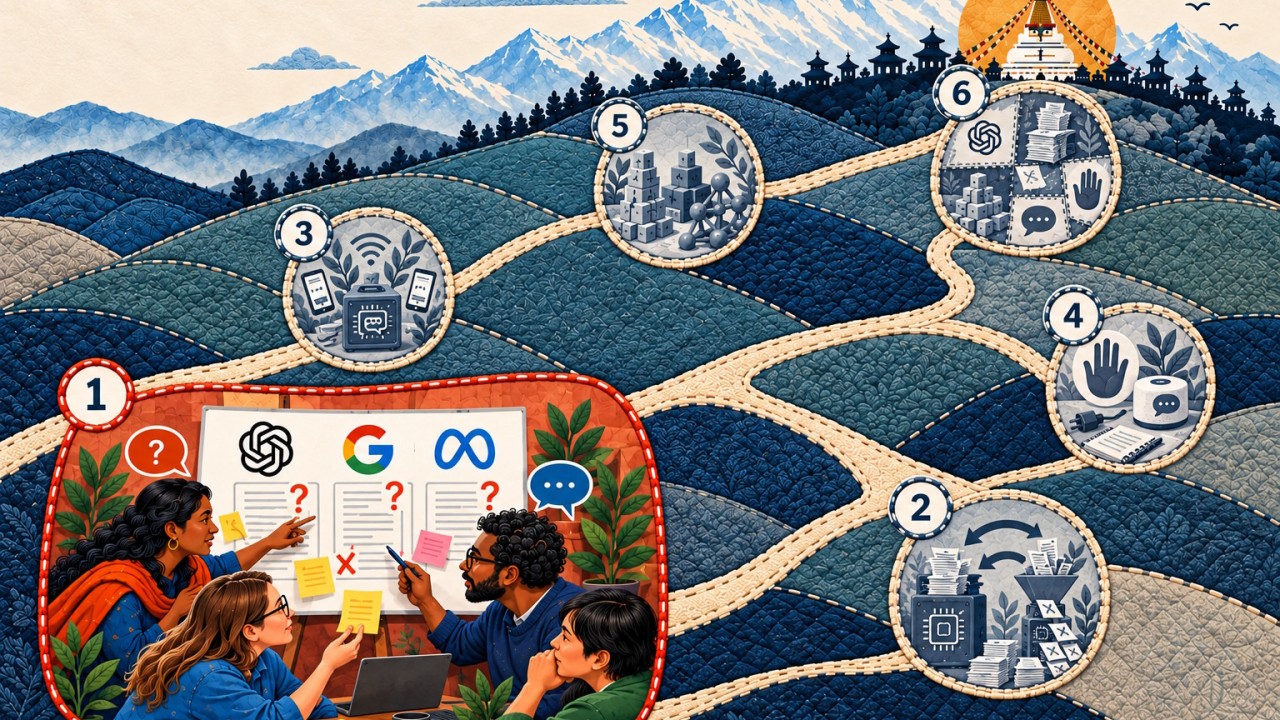
Five of the most interesting discussions were:
1. Maybe civil society can influence the big AI companies?
We both came in feeling that direct influence over the likes of OpenAI and Anthropic was a bit of a non-starter, and that influence might be better exerted via intermediaries with regulatory capacity or significant purchasing power (e.g. UN or governments).
Could a concerted global campaign enable Southern civil society to take part in the processes where companies set and test the rules their models follow? Would it make a difference? It is an interesting idea and one that would move the conversation from if we can have an influence to how we can. Exciting!
It won’t be easy – the discussion highlighted that civil society’s tried-and-tested playbooks for influence were built to pressure governments and international bodies. We don’t know if these same techniques could be effective on Silicon Valley corporations, or on Chinese ones, but we need to find out. Those companies are increasingly likely to sit at the centre of the decisions being made by governments – surveillance, health care priorities, who gets which public service etc., so we have to try!
The main debate here was whether to aim directly at those holding the power, or to build community-controlled examples, connect them, and trust that larger change grows out of many local efforts. Or, ideally, find a way to bridge both, as happens in the climate movement.
2. For AI to be “local” – just sounding like a local is not enough
For many rural communities the barrier to AI is still basic connectivity – electricity, data or access to a smartphone – long before any choice of which AI model or how it was trained comes in.
One widely mooted solution that appears to have enormous promise here is Voice AI – the idea that someone can simply talk with an AI model from a basic/feature phone is understandably appealing. But if people aren’t clear they’re not talking to a real human being, this gets into a very creepy space and the more human sounding the latest avatar voices get, the more likely this is to happen. Add to this the fact that an avatar speaking with a local accent, in a local language – is technically far easier and cheaper than an underlying LLM that genuinely understands the local context, and you have a very real risk that someone is getting what they perceive to be locally contextual advice from a peer, but which is actually based on biased data from a very different context. This is dangerous.
As a sector we are often bad at separating what the private sector will do anyway, from what genuinely needs public or philanthropic money. Here the line looks fairly clear. Market forces are already leading to really good Voice AI, and will likely continue even to include good local accents and some of the bigger local languages (if they see a commercial incentive to reach these people). What is far less likely is for private-sector actors to pay for the locally contextual knowledge underneath these tools, to make it valuable to smaller communities, to make it work in indigenous languages etc.
Funding that enables AI to help such communities (rather than just sounding like it does) is a definite need; well, for those communities that want the access that is!
3. What questions get asked about using AI? Who decided these were the right questions?
There is no shortage of AI “guidance” (there are over 50 policies, governance frameworks etc. doing the rounds). Realistically, this means most people skip all of it and there is a pressing need for simple, practical, power-aware guidance for non-technical practitioners.
One participant argued for straightforward, widely communicated practice, noting that the sector’s communication mostly faces donors rather than the people meant to use it. Even something as basic as providing standard prompts to ensure a power lens is considered could be of value, e.g. “whose voices are missing?”, “who decides?”, “who carries the risk?”, “who is harmed if the AI model hallucinates?”
4. Does it help to build AI that takes us on a learning journey instead of just giving us answers?
We introduced an interesting potential parallel to learn from – some AI work in the education space. The pushback against AI being used to cheat and giving rise to cognitive offloading has led to interesting tools built on pedagogical approaches that don’t answer questions, but guide learners through a process to help them find the answers themselves. The jury is out on their impact but the approach has interesting parallels to this conversation.
For example, could clever AI tool design help to guide practitioners through key considerations of power when designing interventions – helping ensure they tackle the types of questions in #3 above, rather than being used in its normal mode of chasing efficiency gains and skipping over the most valuable thinking stages?
So many conversations around AI tend to assume the ‘tool’ in question is a general-purpose chatbot like ChatGPT but if we broaden our thinking to explore how AI works when embedded in different kinds of tool, there are many more options open to us – building the kind of guided learning journey tool implied above would be far more straightforward if the AI model is used judiciously at key points in specific pre-defined ways, rather than trying to “train” a general purpose model to do this all itself!
5. Power & distributive justice of AI’s socio-environmental cost
The physical footprint of AI is well known (massive data centers, intensive energy consumption, hyper-extraction of rare minerals and millions of gallons of water for cooling systems). What is less widely discussed are the socio-environmental conflicts this is sparking and the fact that these costs are disproportionately impacting rural, indigenous, and vulnerable communities in the Global South and rural margins of the North.
Land grabbing for energy grids, water depletion in drought-prone areas, and toxic electronic waste streams mean that AI is directly competing for the very resources local communities depend on for survival.
Taking a #ShiftThePower lens to this suggests we remain cautious in any advocacy for using or deploying AI. No matter the potential benefits, it is never environmentally neutral. It also suggests that a more nuanced focus on its harms is needed – for example the total amount of water used for cooling is far more of a concern for a data-centre in a location with a low water table than for one where water is abundant.
Some other brief reflections . . .
- The right to say no Some young people now open with “I hate AI” and want to preserve their own thinking and not use it. This led to the suggestion that we must ensure AI literacy and training includes both better ways of using it that don’t replace your own thinking, as well as when not to use it.
- Efficiency is the least interesting benefit of AI. AI is often sold on efficiency gains. These are highly contested and history suggests probably context-specific (the ‘digital office’ promised efficiency gains for decades without delivering as it instead created entirely new types of work. AI shows many signs of doing the same). The more useful question is what a person / group can now do that it could not do before. For an under-funded movement seeking to shift power, this is also a far more exciting question to explore.
- We also briefly discussed the emerging “AI Arms Race” in philanthropy (where organisations use AI agents to generate grant proposals, while funders deploy their own AI agents to screen, evaluate, and filter them out). We will do a deeper dive on this topic in the next conversation on Oct 8.
What should we take from this conversation to Kathmandu?
Thinking back to the very first conversation we had at #ShiftThePower Bogotá in 2023, we reflected that the power dynamics of digital technology won’t be shifted by accident or by passive adoption. We need to get involved, the only question is how – what are the levers of change realistically available to us, and when are there windows of opportunity around which to rally?
AI feels like one of these windows and that suggests civil society is at a critical fork in the road.
- Do we focus on how to use AI to improve our own power-shifting work, but relatively uncritically – not tackling risks such as cognitive offloading, environmental harm and adopting tools built on extractive logic?
- Or do we think we have a genuine opportunity to shape alternatives that minimise harm, enhance not replace critical thinking, distribute energy use more fairly – and to influence big tech AI companies to include civil society in how they are governed, and to mitigate their harm more broadly?
We don’t know yet whether a collaborative effort can make a dent here, but it seems right to try and we will be pursuing aspects of this in upcoming conversations and at the AI Lab in Kathmandu.
If this struck different chords with you, why not bring that to the Summit! 🙂
What’s next
- 8 October – Philanthropy and the AI arms race. How AI is changing grant applications and assessment, and what that means for power, trust and relationships.
- 23 October – “Local” AI. What local, open and public-interest AI mean, and how realistic they are for community ownership.
- 5 November – In whose hands, and saying no. When engaging with AI is right, when refusing is, and who decides.
- 8 November – Shaping alternative AI. Which alternatives are worth backing, and whose voices need to be in those conversations.
To join the conversations, register your interest here (if you are new to this series, there is a little more background on the GFCF site).
This and the following conversations will all feed into a #ShiftThePower #PossibleNow AI Lab at the summit in Kathmandu, 2-4 December. Don’t forget to register!


