
Towards the end of 2025, noticing how many former colleagues were going independent (reasons well known I think!), I wanted to capture what experienced consultants were actually experiencing, and how this could be helpful to other consultants and also to new entrants. Not the generic Build your Brand advice that circulates endlessly.
I gathered interesting reflections from 10 experienced consultants working in the humanitarian and international development space, about how they operate, find work, price, collaborate, and think about AI.
This is not a representative sample, but valuable reflections from thoughtful practitioners with extensive experience across INGOs, UN agencies, bilaterals, and funders. Where they converge, it’s worth paying attention. Where they disagree, I’ve tried to preserve both sides.
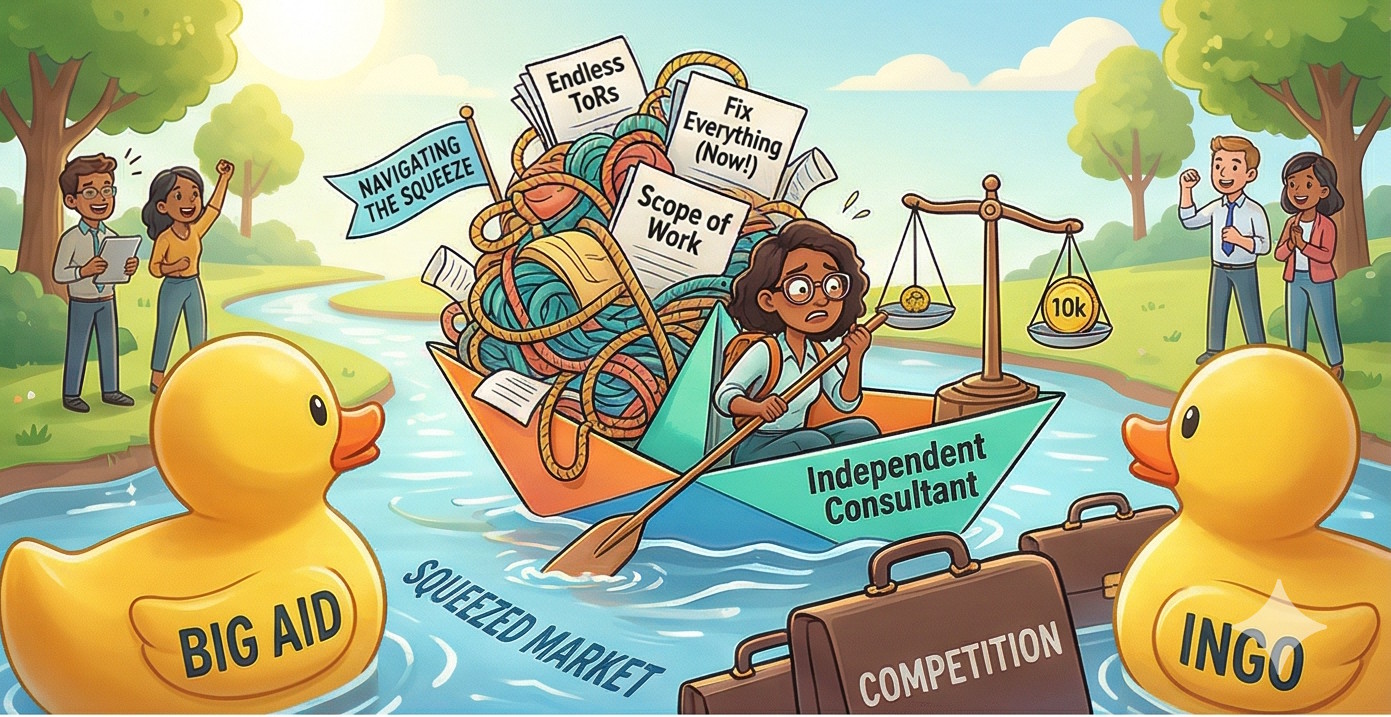
The squeeze
Most of the consultants I spoke to describe a market that has contracted and reshaped. Six of eight who commented on the landscape describe funding contraction, budget-scope mismatch, or clients wanting more for less. One estimated that it seems there are just as many companies and organisations as before USAID was shuttered but maybe 10% of the funding. Another put it more simply:
“Everyone is skint!”
Several describe a crowding effect: more consultants chasing fewer opportunities. One reported hearing that bids that previously received 10-20 good applications now receive hundreds, most of them poor quality (more on that in the AI section). At least two describe client organisations as themselves fragile: high turnover, thinner institutional memory, decision-making that’s slower or more diffuse.
Devex has reported around a 25% drop in advertised development consulting roles, with long-term contracts falling faster than short-term ones. Humanitarian funding projections suggest overall public funding could fall by a third to almost half, returning the system to mid-2010s levels.
Not everyone frames this as crisis. One consultant with over a decade of experience sees the shift differently:
“future problems will be bigger, more complex, less about optimisation, requiring solutions that are fast moving, multi-actor, flexible, boundary pushing. Consultants offering proven best practice offerings for yesterday’s problems will be hard pressed to compete in a world where clients need to reimagine themselves. “
Others describe the landscape in far starker terms
“feels pretty desperate”
“every project feels like it could be my last.”
Both things can be true. The market is harder, and within that harder market, there may be more interesting work for those positioned to do it.
My own experience sits somewhere between these poles. I’ve noticed the squeeze, but it’s been surmountable, partly because I’ve been more active on LinkedIn, developed a more distinctive voice, and spent more time on calls just reaching out to people. But I recognise I may be an outlier, and the structural pressures described are definitely real.
Has the way people find work shifted?
Here’s the finding that matters most for anyone starting out: work comes almost entirely through relationships. All 10 respondents describe existing relationships, former colleagues, referrals, or word of mouth as a primary source of work. One quantified it as roughly 70% coming through recommendations and return work, and 30% through competitive bids. Only one described an even split between word of mouth and formal tenders.
This probably isn’t new. Consulting has always been relationship-driven. But several respondents describe the balance shifting further: more work from networks, less from open pitches. And at least three have reduced or abandoned competitive bidding altogether. One put it bluntly:
“I rarely bid for work these days. Done it a handful of times, but it’s not worth the investment – lengthy proposals, no answers.”
The squeeze is creating a tension here. Some consultants have become more selective, investing only in opportunities where they have a real shot, assessing client readiness before committing time. One described what they look for as:
intent, openness, and decision-making readiness. If those elements are missing, no amount of technical expertise will compensate.
Others are going the opposite direction, forced to bid on more opportunities that are of less interest, not in their wheelhouse, chasing smaller and more marginal work because the bigger opportunities have dried up.
I’ve seen this from the other side. I went for a bid last year with a small group of other independent consultants, around the 50-100k mark, the kind of thing that 2-3 years ago would only have attracted other small consultancies. When we found out who else had bid, some of them were big organisations. They wouldn’t have got out of bed for a project that size before. Big fish in a shrinking pond.
One consultant frames vague asks and absent budgets as potentially a good sign, while another reads the same signals very differently:
“the best projects are ones where the client has a hard problem that they don’t fully understand and don’t yet know how to solve.”
“in many cases, the ambiguity isn’t accidental; it signals internal misalignment, unclear ownership, or a desire to outsource strategic clarity rather than invest in it internally.”
Both agree the response should involve early engagement and co-creation. They disagree about what ambiguity tells you about the client.
One practical note that came through strongly: several respondents described the value of proactive networking, not just waiting for referrals, but actively giving advice, connecting people, and investing in relationships that may not lead to work for months or years. One described spending more time giving advice to their network and connecting other people rather than writing lengthy proposals. I do this too. I spend a lot of time on one-to-one calls with people at all levels, some more senior, some peers, some potential clients, some people just starting out. Very rarely does a call immediately lead to work. But over time, people remember you.
If you’re newer to consulting, this is probably the most important section. Do a lot of networking. Build relationships. Join teams. Consider reducing your rates for high-value or interesting projects if you need to in order to get experience and be remembered. Word of mouth takes time to build. You need people to have worked with you, to remember you.
The commercial reality: rates and risks
Rates are the thing people want to know about but rarely discuss openly. Among the consultants who shared figures, day rates ranged from around $450 to $1,200, with most clustering between $600 and $800, but the headline rate tells less than you’d think.
Views on rate trends are mixed. Some report rates falling, some stagnant, a few have increased over time. There’s no consensus on direction (with a sample this size there shouldn’t be). What does come through clearly is that the bigger shift isn’t in the rate itself but in what clients expect for it.
Several respondents describe what amounts to a systematic transfer of risk from client to consultant. Poorly scoped Terms of Reference are described as more common and worse than before, particularly for international NGOs over the last one to two years. One consultant who works across sectors made the comparison explicit:
“TORs often feel big but poorly scoped – so you respond to the RFP with a number, assuming all of the risk as to the vagueness of the project. In other sectors, it doesn’t work like this and there is more shared risk between contractor and contractee.”
This risk absorption shows up in multiple ways. Consultants absorb scope risk when briefs are vague. They absorb pricing risk when budgets aren’t disclosed. They absorb capacity risk when skinny budgets force solo work where teams would deliver better results. One described the shift in team formation starkly: it used to be driven by getting the best team of people and right mix of skills together, but now it’s much more pragmatic. Does the budget stretch to a team or does it only allow for one person?
I recognise all of this. For every project I’ve ever done, you end up doing more work than you’re paid for. I’m getting better at flagging it at the beginning, subtly reminding people that you wouldn’t expect a permanent member of staff to work for free, so why expect it of consultants. But honestly, it’s just part of the reality.
The respondents’ pricing strategies were more varied and thoughtful than I expected. At least seven of ten describe flexible, context-dependent pricing rather than fixed rates, adjusting based on client type, budget, complexity, role, duration, and personal interest in the work. Rather than accepting lower day rates when budgets are tight, some described working with the total budget envelope, adjusting the number of days to preserve their rate. One articulated a shift not in rates but in clarity:
“What has changed for me is not so much lowering rates, but being clearer about what different price points buy, and more confident in walking away when expectations, budgets, and ambition are misaligned.”
The values-budget mismatch is sometimes stark. One respondent described organisations that purport to be feminist, decolonial, or justice-focused while setting budgets that don’t match the ambition. They cited an example where a well-known sector umbrella body asked someone to evaluate their work on decolonisation for around 10k:
“They can’t be taking this work seriously enough, surely?”
(Note: I’ve written previously about why including budgets, rates, salaries is important, for ethical and equity reasons as well as practical ones!)
How is AI changing things?
All 10 respondents use AI in some capacity. The uses are mostly what you’d expect: summarising data, drafting sections of proposals, editing writing, overcoming writer’s block, checking for consistency. Several emphasised that AI output always needs their human input. One uses it for inspiration but never for contracting advice. The impact on core analytical or strategic work is minimal. One noted that while AI could (and probably should) be shifting the way desk research elements of a consulting project are done, they haven’t yet seen this expectation appearing in TORs.
But the real AI story in consulting isn’t about productivity. It’s about competition.
One respondent described the shift with uncomfortable honesty:
“When I see an opportunity that is a 5 out of 10 match, AI means I might be more inclined to bid – it’s possible to save a lot of time writing technical proposals. This does not feel like a positive experience – proposals without a lot of genuine work feel hollow and not representative of my creativity. If other applicants are also using AI to write most of their proposals, and donors/funders are using AI to review them, it feels like we collectively have gone astray.”
That observation, ‘collectively gone astray‘, is one of the things that resonated with me most. It names something that sector commentary (outside of LinkedIn comments) hasn’t really caught up with: an AI-reviewing-AI dynamic where the craft has been hollowed out on both sides of the procurement process.
Another described the effect from the receiving end:
“organisations that used to get 10-20 good applications to bids, now getting 100s and most are poor. A new consultant on the market looking for work can now basically apply for everything all at once! Add to this that they may come in with a low price – and you can see how skewed the market has got.”
Not everyone shares this anxiety. One consultant explicitly rejects the spray approach, maintaining a targeted approach rather than using AI to produce lots of proposals. Another uses AI primarily to improve the quality of work, rather than reduce time spent on a given contract. These are genuinely different orientations: AI as volume enabler versus AI as quality tool.
There’s also a transparency dimension. At least one respondent described trying to be open about when AI has been used in their work, a norm that feels important but isn’t yet widely discussed in the sector (I’ve been doing this since 2025 and found clients consistently value it).
Some respondents noted that not all clients recognise the skill involved in producing quality AI-assisted work. For those clients, AI is perceived as a reason consultant costs should be lower, overlooking the fact that getting useful outputs requires careful input design, testing, and refinement.
My own AI use is tactical. I don’t write bids using AI, but I use it heavily for initial mapping (here’s my CV, here’s the RFP, am I a good fit? Where are my gaps?). Especially useful across a team of two or three people where the fit (or otherwise) is not so readily apparent. I use it for cleaning up drafts, critiquing my draft proposals, extracting the implicit evaluation schema that’s often just implied in an RFP but not stated. It’s great for rapid eligibility screening too (a few times it’s caught that I’m not eligible to apply because of a detail lurking on p.28 of the T&Cs and saved me wasting a lot of time!)
AI definitely enabled me to do my work faster. In the short term, that’s great, and I can produce more and better quality work for clients. But I have a longer-term worry that I haven’t seen many people discuss: if AI means a six-month project can now be done in two weeks, where does that leave me? Instead of finding one or two projects a year, I’d need ten or twenty. I haven’t seen that compression happening yet, but the logic feels inevitable.
What’s being lost
The budget and competitive pressures described above don’t just change the economics. They change the nature of the work itself.
Multiple respondents described a growing pressure toward intellectual conformity. As budgets shrink, there’s less time for the relationship-building that makes genuine challenge possible, and growing temptation to simply deliver what sits within the client’s existing imagination rather than pushing boundaries. One respondent connected this directly to budget size: smaller consulting budgets leave less room for the trust-building and reframing that systems-level work requires.
This connects to a broader shift in what consultants are being asked to do. One described it clearly:
“Consultants are increasingly brought in not just for technical expertise, but to provide continuity, external perspective, and momentum. This changes the nature of the role: it involves more facilitation, sense-making, and holding space for uncertainty than it did even a few years ago.”
That shift may be valuable. Sense-making is arguably more important than technical delivery in a turbulent environment. But it’s happening under duress, not by design.
The values-practice tension runs through the data. Consultants describe bidding outside their expertise because the market demands it. Using AI in ways that feel inauthentic. Self-censoring to avoid alienating clients they depend on for future work. The power imbalance for individual consultants is real. As one noted, you want to be considered for future work, which makes flagging poor client behaviour feel risky. These aren’t individual failures of nerve. They’re structural pressures created by a buyer’s market.
One respondent directed a warning at donors and clients:
“if enough small consultancies and independents die off, they will get worse bids in the future and will end up funding just a few lucky organisations.”
The ecosystem that produces good consulting requires investment, from both sides. When every project is a race to the bottom on price, everyone loses (let’s be honest, the consultants lose first, but the quality of the work follows).
What does this mean for consultants new to the sector?
If I had to distil one thing for newer consultants from all of this, it would be this: of course networking remains critical, but before you arrange a lot of chats, invest some time in making sure people will remember you and how you fit in to their mental map. Be able to describe your work and value clearly in 1-2 sentences. Word of mouth is clearly how a lot of work is being found, it takes longer to build than you think, and it’s next to useless if all people remember is you “seem nice” but they can’t place when you’d be a useful collaborator, or what opportunities to consider forwarding to you.
What these reflections don’t show
Ten people is not a representative sample. These are all experienced, mostly Northern-based consultants. There is only one Southern voices here, and that’s a significant limitation for any discussion that touches on localisation or who should be doing the work. One respondent noted that more national consultants from Africa, Asia, and Latin America are picking up work, framing it as a good development while others highlighted the competitive pressure this also brings. This piece can’t do justice to that question, and I won’t pretend otherwise.
If you are one of the under-represented voices – a new or an experienced consultant based in the global South – I’d love to hear your experience for a potential follow-up.
If you’re a donor or organisation navigating this from the commissioning side navigating how to scope work better, thinking about AI in procurement, seeking to understand your potential impacts on the global South – those are the kind of conversations I enjoy.
Thank you to the 10 people who generously shared their time and reflections for this piece. All quotes are anonymised throughout, but the people who made it possible are: Dee Jadeja, Fred Marree, Dan McClure, Troy Etulain, Aradhana Gurung, Ian McClelland, Rosie Jackson, Alice Livingstone Chan, Hannah Reichardt, and Matt Jackson.
Some related further reading:
- Devex, “How development consulting jobs fell 25% – and how to adapt” (2025)
- ALNAP “Global Humanitarian Overview” (2025)
- Devex, “The new reality for global development consultants” (2026)
 Matt Haikin