
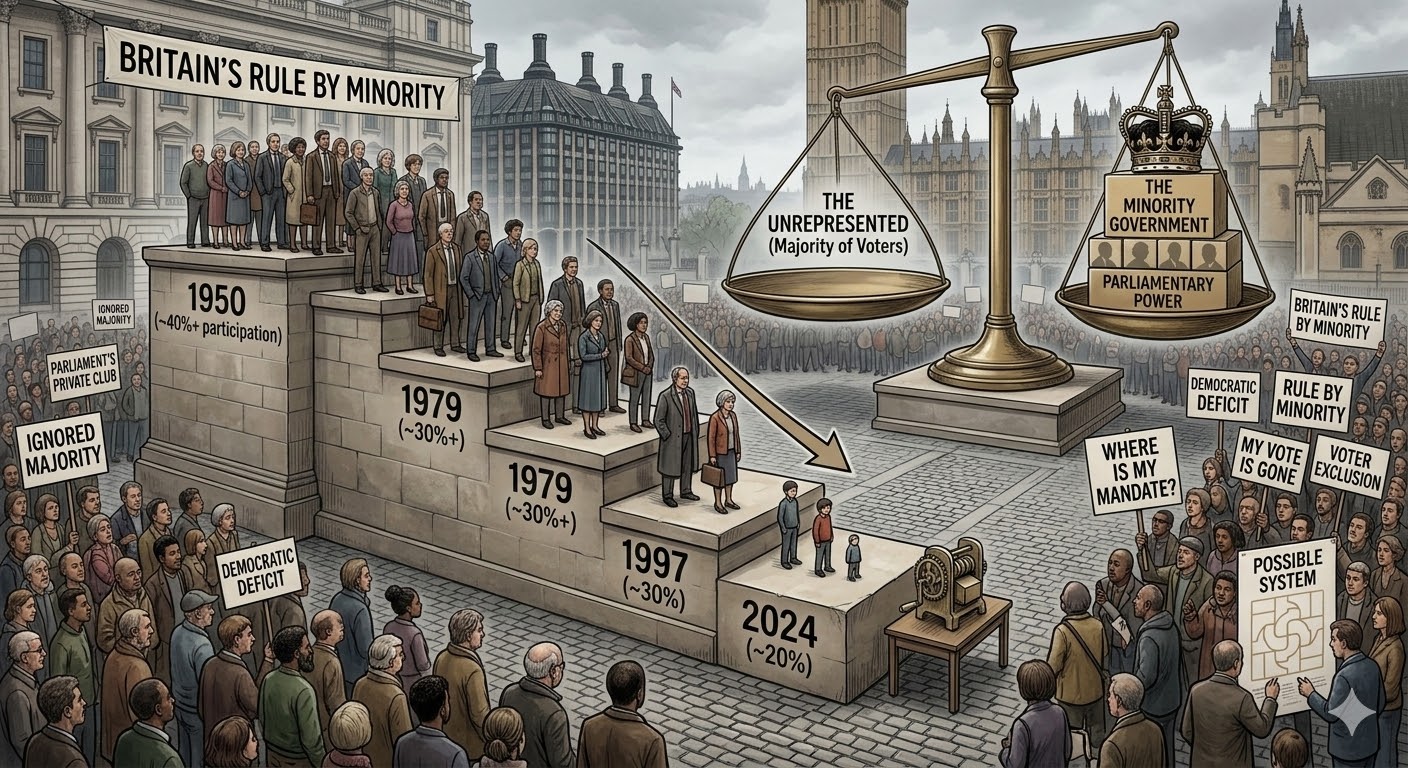
Someone on LinkedIn pointed out recently that Keir Starmer’s government is supported by only about 20% of registered voters. True. Labour won ~34% of the vote on ~60% turnout, which means about one in five people on the electoral roll actually voted for the party now controlling Parliament. Why aren’t we up in arms about this?
Because despite the shocked implication that this makes Starmer unusually weak, it doesn’t. It makes him entirely the norm.
Britain has never had a democratic government. Ever.
Clement Attlee, regularly cited as one of Britain’s greatest prime ministers, was elected in 1950 with the support of about 39% of the electorate. Margaret Thatcher in 1979: roughly 33%. Tony Blair’s famous 1997 landslide: around 31%. By 2005, Blair was governing with the backing of about 21% of registered voters. Starmer’s 20% is the lowest yet, but it sits on a clear downward trend that has nothing to do with any individual leader.
No UK government since 1918 has been elected by a majority of voters. Not one. The closest was the 1931 National Government coalition, a cross-party arrangement that barely counts. For a century, every British prime minister has governed with the active support of a minority of the electorate. Usually around a third. Sometimes far less. Britain champions democracy around the world while never having produced a government backed by a majority of its own voters.
The defence of first-past-the-post was that it sacrificed fairness for effectiveness. The system never attempted to represent voters proportionally. It converted minority vote shares into decisive parliamentary majorities. One party won. It governed. It could be thrown out at the next election. Minority mandates were the price of stability. You might not like the government, but you got a government.
That was never democratically defensible. But it functioned. And that is what is now crumbling.
So what has changed?
The bargain depended on a precondition: a two-party electorate. In 1951, Labour and the Conservatives between them won about 97% of the vote. When almost everyone votes for one of two parties, first-past-the-post translates votes into seats with tolerable accuracy. The distortions exist but stay modest. The winning party gets a few extra percentage points of seats. The country gets a functioning government backed by – if not over half the voters, at least not too far off.
Two shifts broke that precondition:
- Turnout collapsed: from 84% in 1950 to around 60% in 2024.
- Voting has fragmented: the two-party share fell from 97% to about 57%. Votes are spread across more parties.
The electoral system has not adapted to either shift. It still operates as if two parties dominate every constituency. They don’t.
The result is a new kind of distortion. In 1997, Blair won 43% of the vote and 63% of the seats. In 2024, Starmer won 33.7% of the vote and 63% of the seats. Same parliamentary dominance, far weaker mandate. The gap between votes and seats in 2024 was the largest in modern British history: nearly 30 percentage points. A party backed by a third of voters holds almost two thirds of Parliament.
And the system may not even be able to keep doing even this for much longer. Current polling shows four-party fragmentation so severe that Electoral Calculus gives a single-party majority only about a 1 in 4 chance of occurring at the next election!
Doesn’t everywhere have this problem?
Some countries, yes. Trump won the presidency in 2016 with nearly three million fewer votes than Clinton. India’s FPTP system gave the BJP 55% of seats on 37% of the vote in 2019. In Canada, Trudeau won 33% of the vote in 2021 and governed alone.
But other democracies handle it differently. Germany’s proportional system produced a coalition in 2021 where the largest party won just 26% of the vote, but the government collectively represented over 50% of voters. Australia’s preferential voting means the winning side ultimately needs majority support after preference transfers. None of these systems is perfect. But proportional and preferential systems at least produce governments that can plausibly claim to represent a majority. Britain’s cannot.
We’ve never had a democracy. But we did have a system that produced something that functioned and we could pretend was one. That pretence is getting very hard to sustain.

 Matt Haikin